Boom! Boom! Boom!
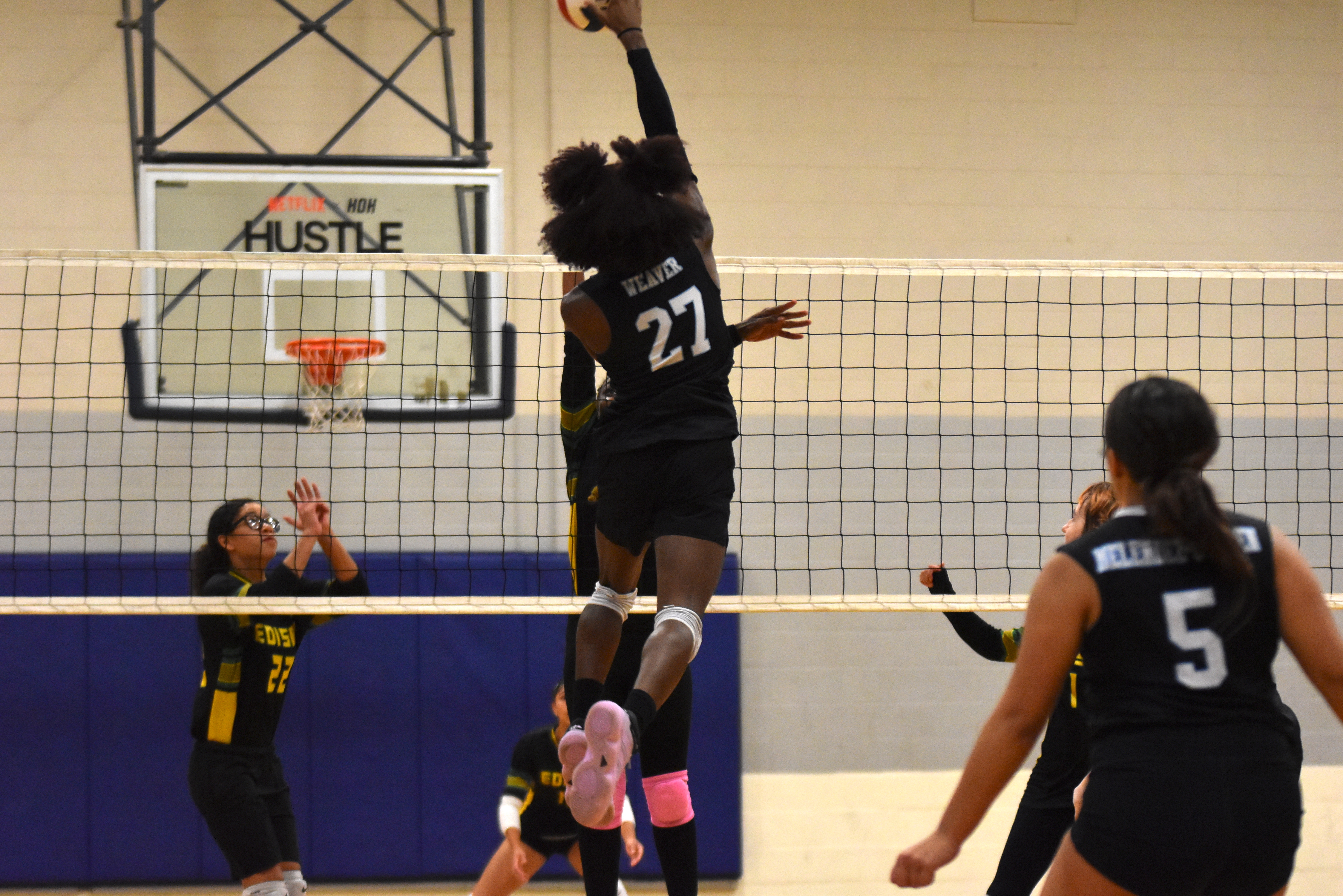
Brooklyn Weaver slaps the volleyball in preparation for a serve, and the crowd at the Palumbo Recreation Center stomps its feet in unison. They’ve come to cheer on the Philadelphia High School for Creative and Performing Arts’ girls volleyball team, and Weaver’s 1-2-3 pounding pre-serve ritual creates a crescendo through the crowd as she leaps and serves a powerful dipping ball into a swarm of six opposing players.
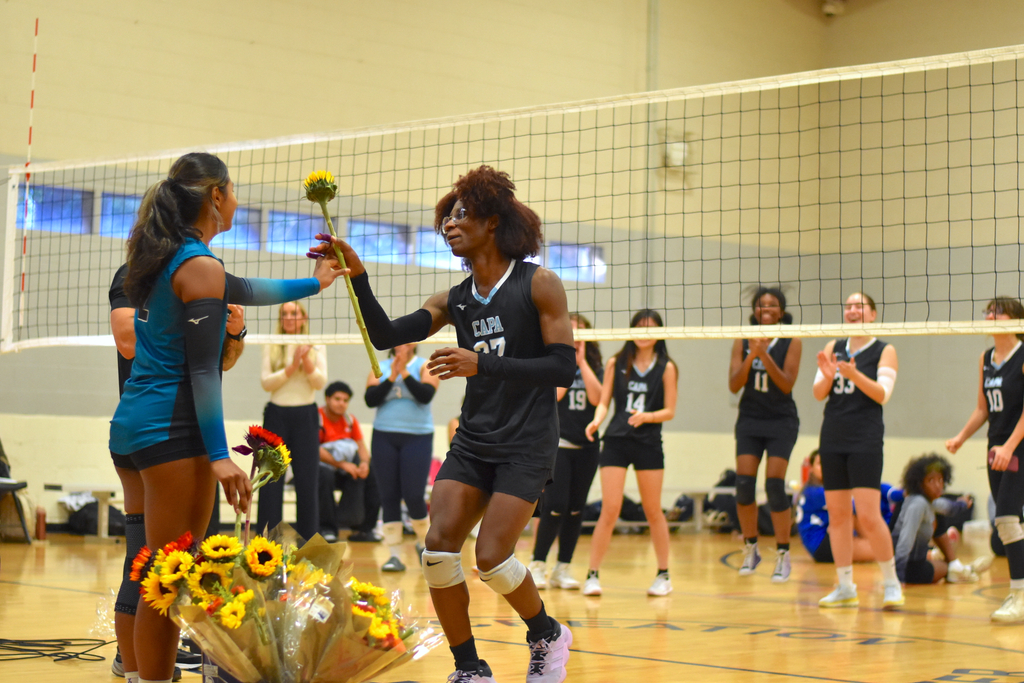
The CAPA fans love her. Her teammates adore her. Even most opposing teams in the Public League throw their support in her corner. But Weaver’s situation is one that is clouded in controversy well beyond the cement seating at the Palumbo Rec Center in South Philadelphia.
Weaver was born a male but began identifying as a female five years ago. She plays on an all-girls team, which is allowed because Pennsylvania has no state law governing transgender participation in school athletics.
For Weaver, it’s a place where she can play a sport with her closest friends in a safe and accepting environment. For others, it can be seen as a clear disadvantage as Weaver’s athleticism jumps off the charts and gives the Pegasus a strategic edge. She leads her team in kills and blocks this season by a healthy margin.
“When you see someone like me, you’re going to be a little questionable because I’m not sure if there’s ever been a trans player before in Philadelphia,” Weaver said. “Me being the first at CAPA, I definitely had to break a lot of mental boundaries. But I always had my teammates and my coach to lean on. We were very big on becoming a family.”
Humble Beginnings
Weaver never played a sport before joining CAPA’s girls volleyball team as a sophomore in 2024. She was introduced to volleyball a year earlier in gym class and became hooked.
“When I was a freshman, we played volleyball in gym class and I never really knew much about the sport. I just thought it was fun,” Weaver said. “I had a lot of friends in my gym class that played it so I took an interest and started playing more and more. I wanted to try out for varsity, but I wasn’t sure if I could.
“I emailed our athletic director at CAPA and she let me know that I am able to try out as a trans player. I went into tryouts fully thinking I wasn’t going to make the team because everyone else there was really good and really tall. I was thinking they probably weren’t going to take me.”
Weaver admitted there was some anxiety in stepping onto the court the first time.
“I knew a few (teammates) from class, but I wasn’t really close with them yet,” Weaver said. “I think the person I was closest with is Akira McCall because we are in the same theater class at CAPA. Being able to just play volleyball with her and be in theater together helped me adjust to this new environment with other people, which was very nerve-wracking.”
Some of the anxiety came from the opposition at first.
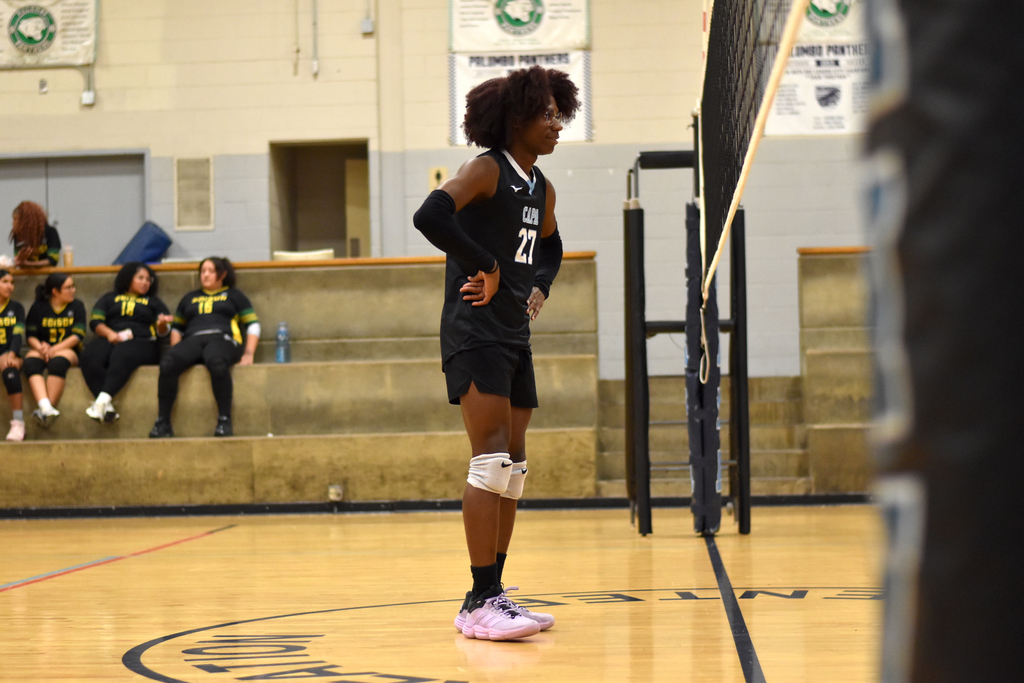
“I think most of the awkwardness was my own fear,” Weaver said. “My teammates didn’t necessarily care about my identity. They just wanted to look out for me. I remember my sophomore year, there were definitely some other teams that made me feel awkward or maybe even just from the crowd where I felt that awkwardness or fear.”
Law in Motion Stays In Motion
In June, the Supreme Court made a ruling that opened the door for Pennsylvania lawmakers to adopt new rules based on biological sex for school sports and legislation.
Before that had even happened some states, including Pennsylvania, had already introduced bills to prohibit biological males from competing in female sports.
PA House Bill 158, known as the “Fairness in Women’s Sports Act,” has received favorable consideration, passing through the House’s Education, Health and Judiciary Committees but has yet to see a House floor vote.
State Rep. Martina White (R-Philadelphia), who represents Northeast Philadelphia and is a former collegiate field hockey player, is a prime sponsor of House Bill 158. She has watched the bill pass at the committee level but stall out repeatedly.
“There are Democrats who have privately indicated that they would be supportive if it came up for a vote so we know for a fact it would pass on the House floor,” White said. “But the Democrat leadership continues to basically have the chairman of the committees pass the bill from committee to committee instead of having it go to the House floor for a vote. They are preventing it from coming up for an actual vote.”
The proposal, which was introduced by Rep. Barbara Gleim (R-Cumberland), mirrors Senate Bill 9, which passed the Senate last year but has also yet to receive a vote in the House. White said that the lack of laws regarding transgender athlete eligibility creates an uneven playing field.
“As it stands, a school district in one area could have a different policy than a school district in another area and it could even go from school to school,” she said. “It’s going to make it difficult for fair competition in Pennsylvania.”
She sympathized with the possibility that a rule would leave transgender athletes on the sidelines, but she emphasized protecting female athletes.
“We do want every student to know that they deserve dignity and respect and I think at this point, at the same time a female athlete deserves a fair opportunity to actually compete,” White said. “By design, that’s what Title IX was created to do — to expand opportunities for women and girls and protect those opportunities so they don’t get bumped out from opportunities like scholarships. When you’re competing at those levels, it becomes even more important.”
State Rep. Elizabeth Fiedler (D-Philadelphia), a former teacher who represents parts of South Philly, is on the opposing side.
“Trans kids should be able to play sports consistent with who they are,” Fiedler said. “School sports should be a safe place for kids to grow, express themselves and build relationships during crucial years of development. Laws and policies that encourage discrimination of minors based on their gender identity or even their appearance violate their privacy and make all kids less safe.”
A Successful Failure
House Bill 158 wasn’t the first attempt by a largely Republican effort to segregate sports in Pennsylvania by biological birth. In 2022, PA House Bill 972, which was described as “An Act providing for sport activities in public institutions of higher education and public school entities to be expressly designated male, female or coed; and creating causes of action for harms suffered by designation” passed 115-84 by the House and 30-20 on final passage by the Senate. It was also introduced by Gleim and co-sponsored by White.
However the bill was vetoed by then-Gov. Tom Wolf.
“The bill denies opportunities to transgender youth, which would have a devastating impact on a vulnerable population already at greater risk of bullying and depression,” Wolf said in his veto statement. “The harmful impact of politicizing transgender and other LGBTQ+ issues is evident by increasing rates of suicidal thoughts among LGBTQ+ young people. Even if enacted, this bill would face legal challenges for violating federal law and constitutional guarantees of equal protection.”
Wolf’s veto came a few months after University of Pennsylvania swimmer Lia Thomas won an NCAA Division I championship in the 500-yard freestyle event. Thomas, who began her career on Penn’s men’s swimming team, changed her gender identity while at the university and underwent hormone replacement therapy, which caused the loss of muscle mass and strength.
“I was a collegiate athlete and I’ve seen what many of these women have experienced,” said White, who played field hockey at Elizabethtown College. “I’ve heard from the UPenn students first hand and it just concerns me that young women and girls are not being protected when they have to compete against a biological male.”
Medically Transitioning
Weaver said she began hormone replacement therapy in September after a long, thought-out process. After coming out to her parents in 2021, Weaver began speaking to a psychiatrist in 2023. After three years of conversation, she received the green light from her therapist to begin the hormonal transition. It was another reason she wanted to play on the girls team instead of CAPA’s boys team.
“I figured that would match my identity better,” Weaver said. “And I always had the plan to go on hormones and start medically transitioning so it would be weird if I tried out for the boys team and by senior year, be like, ‘Oh, I’m not actually a boy anymore so I don’t want to be on the boys team.’ ”
Weaver said she first experienced the effects of the therapy in a match against George Washington Carver High School on Sept. 10
“The Carver game was really a challenge for me because my body was still getting adjusted to the hormones,” Weaver said. “If you look at the (video) footage, you could see me running off the court to drink water because it really makes you dehydrated. It’s still been a weird adjustment.”
She said she had to adjust her game.
“I can already feel physical changes like with muscle mass,” she said. “I get sore much quicker now than I normally would. I have to be more technical now.”
The Other Side of the Net
Neumann-Goretti doesn’t play against CAPA.
The Saints are a member of the Catholic League and play very few crossover games with public schools, therefore the issue hasn’t come up directly, but coach John DeRenzi considers himself a supporter of women’s sports and a fan of the WNBA. He separates his opinions on lifestyle and sports.
“I am 100-percent for a transgender person. That’s their own,” DeRenzi said. “But I don’t feel that a biological male should be playing in a woman’s sport.”
The WNBA has not had a known trans player in its league and its current collective bargaining agreement prevents it. However, the league experienced staged rallies at Indiana Fever games both for and against transgender inclusion after guard Sophie Cunningham said in an ESPN article that she supports barring transgender girls and women from girls’ and women’s sports.
“I’m not going to say that a man is more gifted, but a man’s muscle structure is bigger and it would be an advantage,” DeRenzi said. “God bless them, but when it comes to sports, there’s a WNBA and an NBA. Women and men. And I just believe it should stay that way in all sports.”
At the high school level, Academy at Palumbo volleyball coach EJ Goldstein takes a different stance. He said the Griffins faced a transgender athlete in previous years and his team also played against CAPA the last few seasons. Goldstein was in full support of Weaver on the opposing side of the court. But before he made a decision, he asked his players.
“I had a conversation with my athletes about it and my girls were all super supportive,” Goldstein said. “Sure, there was a level of feeling of, from a physical standpoint, is it fair or not fair? But they were all very supportive. We had a frank conversation about it and at the end of the day, we all agreed you are who you are and just be you. And people should be comfortable to be who you are despite what all the outside noise might be. I’m a huge supporter.”
Pegasus Power
After struggling during Weaver’s sophomore season, CAPA added to its trophy case in 2025 by going 8-6 and winning the Philadelphia Invitational Tournament, which is a consolation bracket of teams that missed the PPL tournament. Weaver led the team with nine kills in the championship game, which was played on her 17th birthday.
The Pegasus were 4-5 this season through Oct. 12. But for Weaver, the wins and losses carry little significance in comparison with the camaraderie she found on the team alongside her classmates and theater buddies.
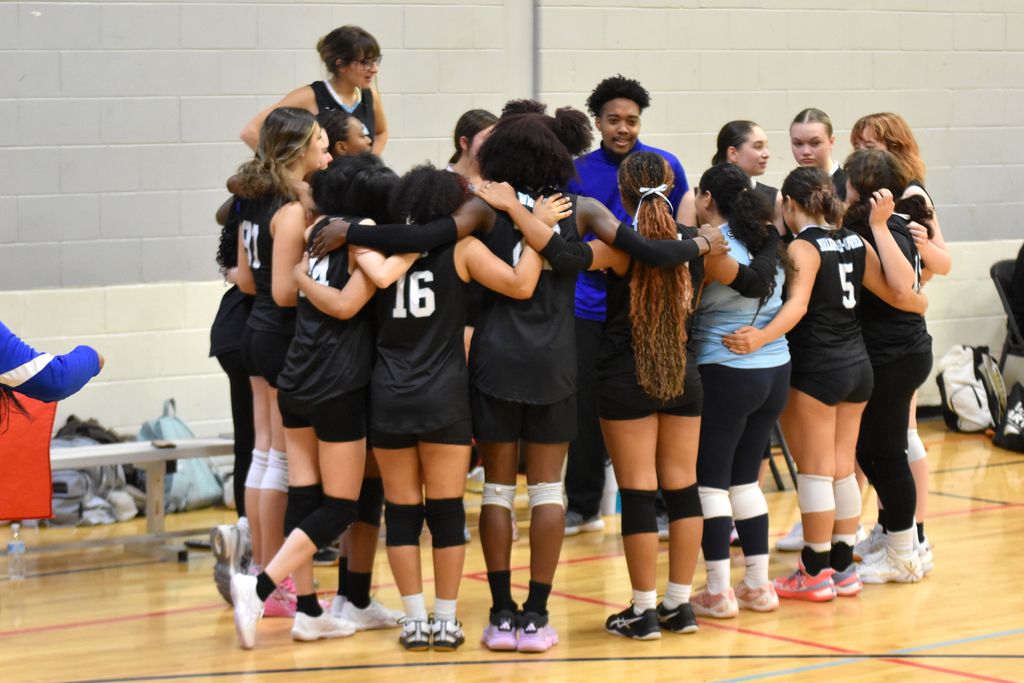
“At school I am kind of seen as an extrovert but I would say people are more just attracted to my energy,” Weaver said. “Coming on this team was really scary, but everyone is super nice.”
What’s Next?
Each time House Bill 158 passes through another committee, the clock resets to determine the next action. In July, it was re-referred to the House Health Committee, where it had already passed 15 days prior.
If the bill ever does reach the House floor, and subsequently passes, it would be sent to Gov. Josh Shapiro’s desk for a signature. Shapiro, a Democrat up for re-election in November, has previously spoken out against the measure.
White is continuing to fight for the parents of female athletes who have expressed their concerns.
“I’ve played sports literally all my life, from soccer to field hockey to basketball,” she said. “I can appreciate where these parents are at. It’s unfortunate that this is the place where we’ve arrived when it comes to these policies. But as legislators, I feel compelled to protect these young women so they don’t have to worry about changing in a locker room or trying to compete and worry about safety and well being. I think it’s a fairness issue and I’m going to definitely continue to advocate for these young women and I think that’s what many parents want us to do as well.”
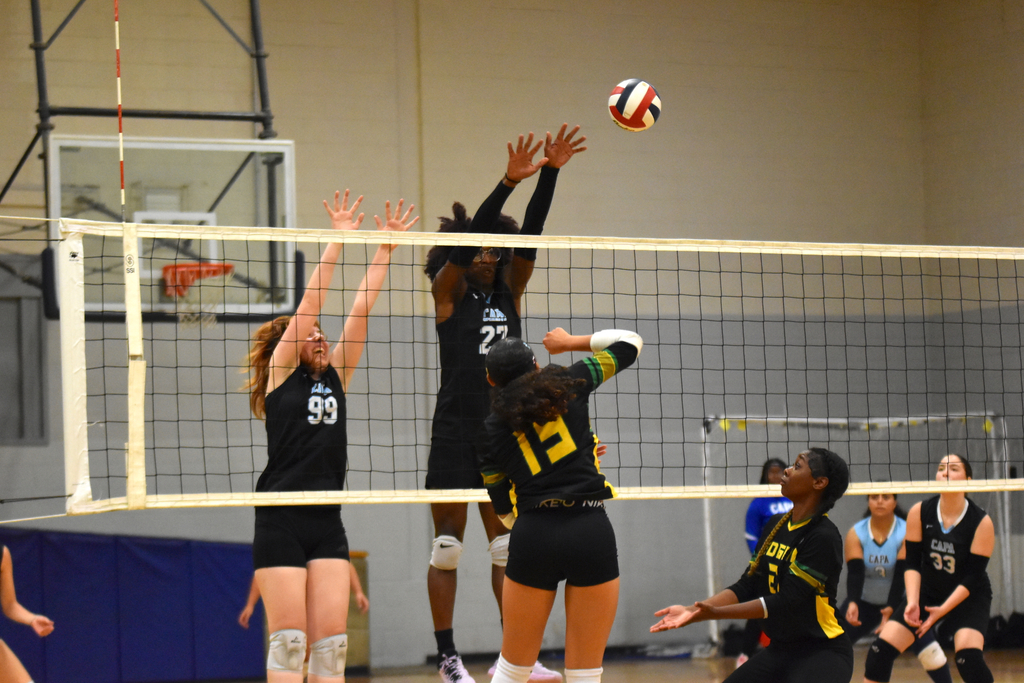
Whether the state acts, a decision won’t come down until Weaver and CAPA have completed their final season together.
“I really love being on this team,” she said “I love my teammates and my coach. These people are some of my best friends and I’ve learned so much from them, not just from volleyball, but from life. If I hadn’t joined this team, I wouldn’t be as close with them and we wouldn’t have that same connection. Playing volleyball in general has really helped with my mental health.” ••


