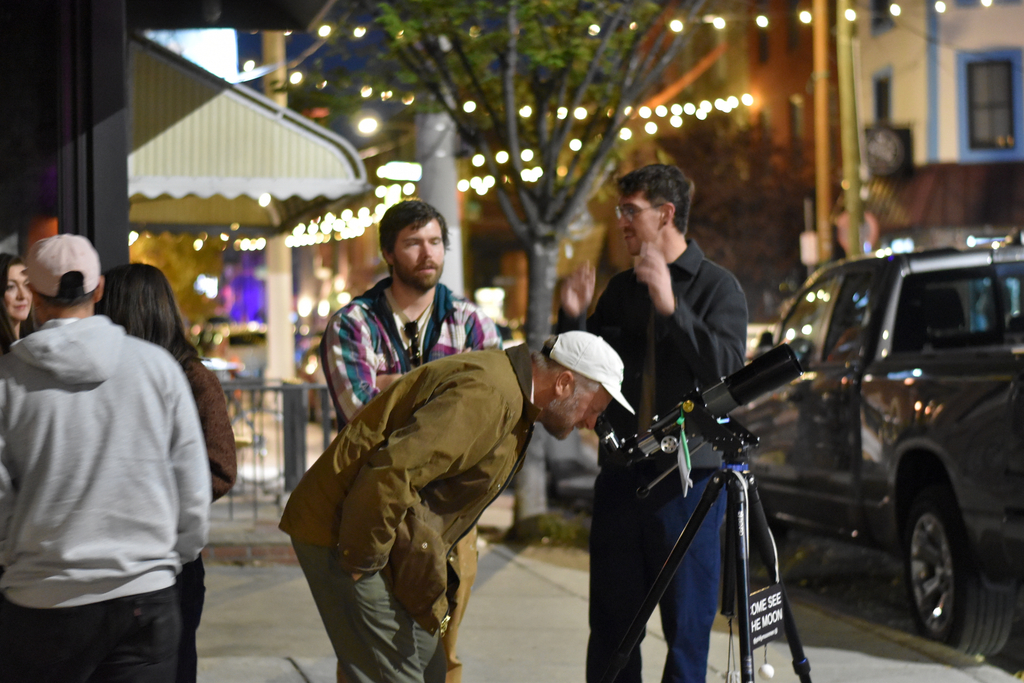
“Hello! Welcome. Do you want to see the moon?”
Brendan Happe’s greeting to pedestrians along East Passyunk Avenue is warm and his offering is worthy of taking a long look. Happe’s passion is sidewalk astronomy and it’s his way of giving everyday people a chance to glance into the cosmos through his refractor telescope. He says, quite simply, his goal is to remind people they are living on a planet.
“100 years ago, we could have stood on this street corner and seen the whole Milky Way,” Happe said. “And I wonder what it was like for people back then to constantly be reminded that we’re in a universe on a planet. Because of light pollution, that’s gone.”
Happe grew up on Long Island but moved to Philadelphia with his brother, Bill Green. Around eight years ago, the two began glancing at the moon with a pair of binoculars and offering others to do the same along South Street in front of the Theatre of Living Arts. They soon after began calling themselves “Philly Moon Men” on social media.
“The first time I saw the moon up close was on South Street through my brother’s binoculars and that’s the same night we started soliciting passers-by to see if they wanted to see it, too,” Happe said. “I didn’t know anything about the moon that night or the next 20 nights we did it. But we just kept doing it. I wanted to know more about astronomy.”
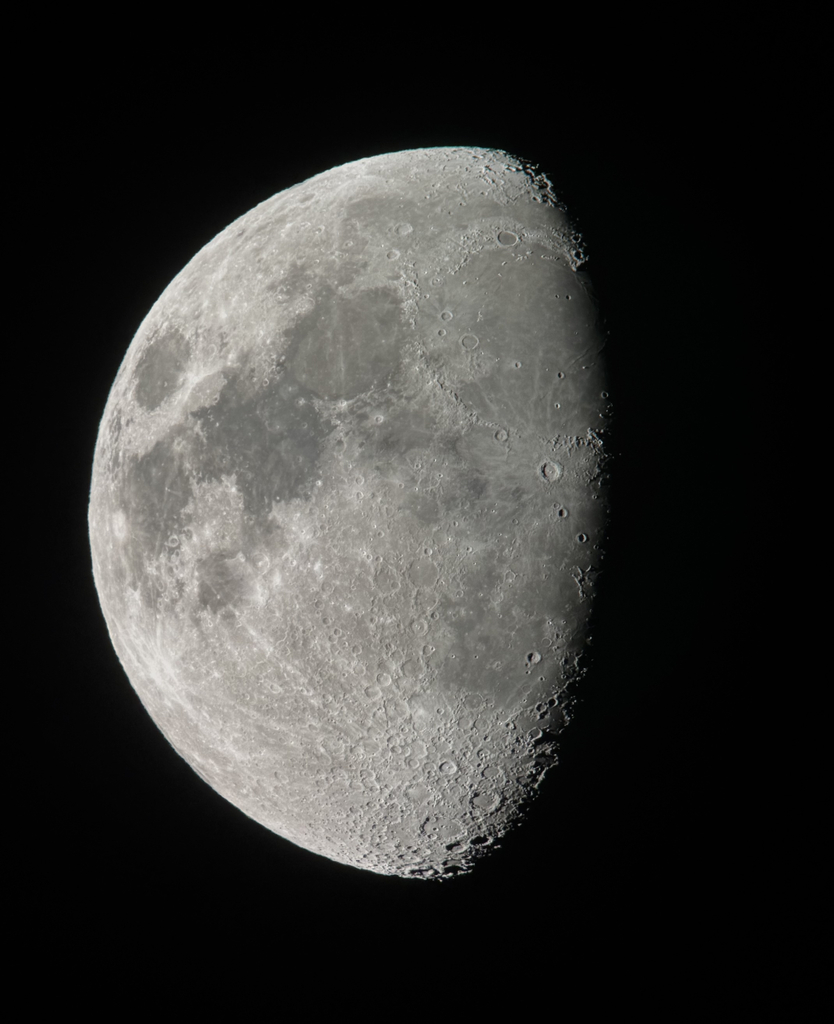
Happe made it his passion project. His brother Bill made it his livelihood. During the pandemic, Green moved to Brussels to pursue his master’s degree in optical engineering. He then moved to Germany on a government grant to provide sidewalk astronomy, pairing up with a German observatory for outreach work. He moved to Copenhagen last year to work for a camera company and continues to do sidewalk astronomy in his Danish neighborhood.
When conditions are good, both brothers will look at the same planets, stars and moons in the sky from different continents.
“There’s nobody else in my life that I can talk to about this experience other than him,” Happe said, noting that the last time they saw each other was at their sister’s wedding last year in Florida. “We’re brothers but we also have this additional layer that connects us. We think about sharing a view through a telescope with people and we share tips and advice and experiences. People have looked at the moon and started crying because it was so impressive to see it.”
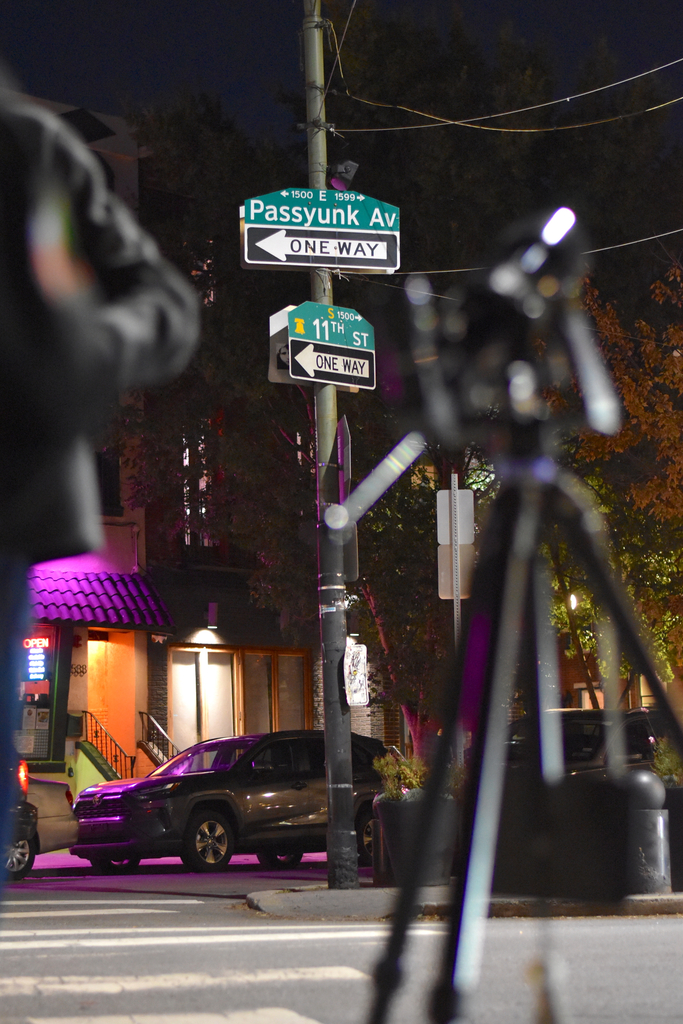
On clear nights, Happe sets up near the Singing Fountain on East Passyunk and asks people if they’d like to share the view. Some are first-timers. Others return to seek out Happe for another peek.
“My 2-year-old is obsessed with the moon so we are always tracking it through the sky but we never get to see it up close,” one South Philly parent said as her child looked through the telescope.
Happe enjoys the interactions. He’s a master of hospitality, working as a restaurant manager at The Prime Rib inside Live! Casino and Hotel Philadelphia on Packer Avenue. Once the dinner rush is done, Happe grabs his telescope and heads to East Passyunk. It’s there that he finds heavy foot traffic and scientifically curious bystanders.
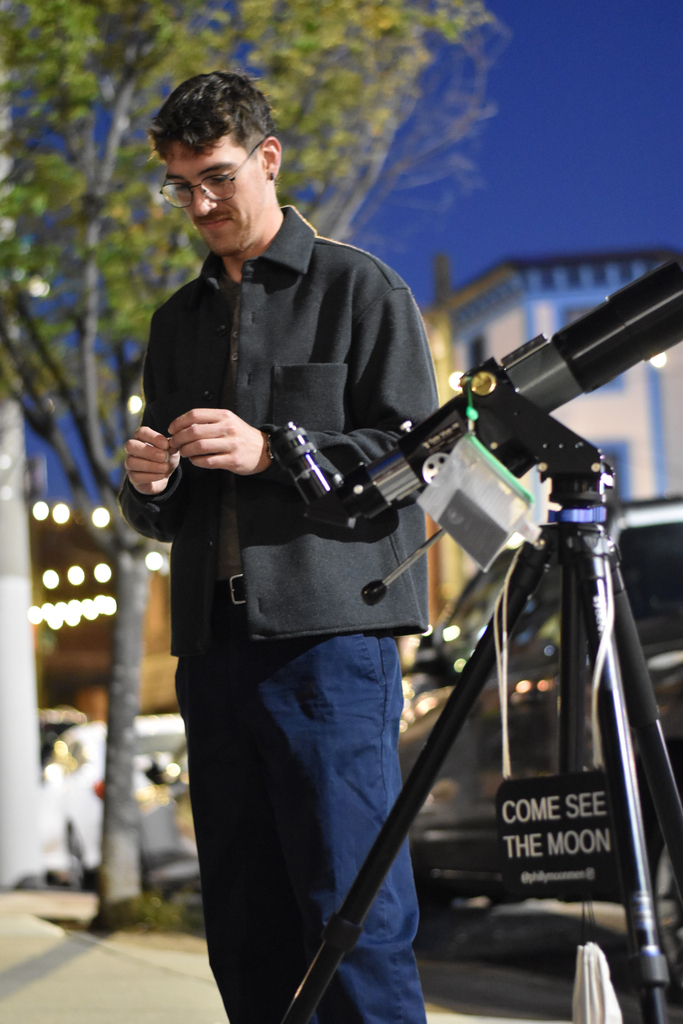
“I used to do this on South Street and the reason was because there was a lot of foot traffic,” Happe said. “This triangle is similar. There are a lot of people and businesses around. My aim is to reconnect people with the night sky. Being near a high-volume sidewalk is important.”
So is being knowledgeable about the night sky, which Happe admits he learned on the fly. Most of his knowledge came from the tens of thousands of proverbial students with whom he has interacted.
“There’s something about this experience that I’m not really tour guiding,” Happe said. “People see the moon and now they are curious about it and have questions. I’m here to hopefully have the answer for you. And if not, I will do my best to find it.”
Happe says in a good month, he might be out to view the moon around four or five days, depending if the view is clear. Sometimes there’s even more promise if the stars — or planets — align.
“The best sidewalk astronomy season is when you can see both Jupiter and Saturn in the evening sky and the moon is out,” Happe said. “You can take a tour of the solar system from any sidewalk. It’s more engaging than just seeing the moon.”
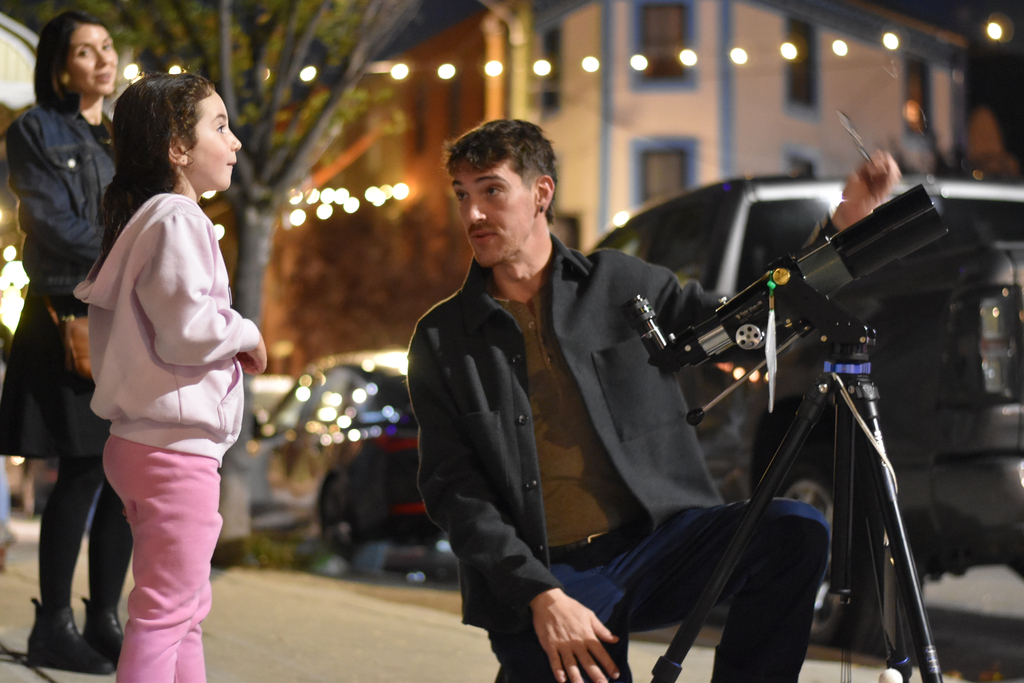
Happe teaches people how to look through the telescope and he’s happy to adjust the height of the apparatus for children. While he does, he can offer his opinion on whether Pluto should be considered a planet or describe his excitement about shadows during a 62 percent waxing gibbous.
Most of all, he wants everyone to see the moon about 50-120 times closer.
“It brings a tremendous amount of joy,” Happe said. “I call it the most interesting thing about my life. But it makes me feel a way that nothing else I’ve ever done does. I remember seeing the moon up close for the first time. Coming from a light-polluted place in New York and being like wow, I never realized the whole universe is out there. I thought if more people could experience that, it would be a net positive.” ••