BY CHUCK DARROW
Sometimes, a hobby is just that — a hobby. And sometimes a hobby winds up being a decades-old global business, like Matt Eichen’s hobby.
Eichen, 64, a New York City native and longtime Cherry Hill resident, is the founder, CEO and chief designer of the Musicvox guitar line, which next year will celebrate its 30th anniversary, not that the retired oral surgeon ever had that second career on his bingo card.
Looking for a one-off
Primarily a drummer in his youth, the Rutgers University and University of Medicine and Dentistry of New Jersey alum began collecting a certain type of electric guitar while in college. He specifically focused on those favored by members of bands that dealt in the 1960s sub-genre of pop called “garage rock.” According to Eichen, members of these groups often played guitars bearing brand names like Silvertone Harmony and Egmund (Paul McCartney’s first electric guitar). They tended to be somewhat adventurous in their designs and boasted price points far below those of more popular brands like Fender, Gibson, Rickenbacker and Guild.
Although his studies took him away from performing music, his love of these down-market instruments never left him. In 1996, he decided to design his own guitar as an homage to those he collected. There was no thought given to creating a business. But when he solicited a guitar builder on the west coast, he was advised that the cost to build just one would be so high, he may as well start a company to commercially market them. Thus, the Musicvox line was born.
“We were incorporated in September 1996. From September ’96 until Jan. 1 it was a mad dash to finish a design,” recalled Eichen during a recent interview at his Cherry Hill home. The guitar he created was the Spaceranger, whose eye-popping design includes an exaggerated “horn” protruding from the body and a crescent-shaped head stock (where the tuning keys are located) that made the “ax” look like something from “The Jetsons.” It remains part of a line that now includes 13 different guitars and bass guitars.
A memorable debut
One reason for the urgency was Eichen’s desire to show off his creation at the musical-instrument trade show staged by the National Association of Music Merchants (commonly known as “NAMM”) that takes place annually in late January in Anaheim, California. Not that he was initially met with open arms at the expo.
“There was a journalist from, I think, Sweden,” said Eichen. “And, you know, some of the Northern European countries are very meticulous about form and function and not so much aesthetics.
“He looked at these instruments, and he was the most incensed person at the show. He raised his voice and said [imitating a northern European accent], ‘Vhy you did such a thing? Vhy you did something like this? How could you do something like that?’ ”
But, continued Eichen, things took a turn for the better toward the end of the show. “As I’m putting my stuff away, people start coming up to me saying, ‘I’m from Guitar World [magazine].’ ‘I’m from Guitar Player.’ ‘I’m from Maximum Guitar.’ And the one from Guitar World said, ‘You have the coolest instrument at this entire show.’
“So, I did multiple interviews with all these magazines. And within six months, the whole world had heard about Musicvox.”
Enter ‘Austin Powers’
Not surprisingly, getting famous musicians to acknowledge — and better yet, play — a firm’s instruments is a priceless, and crucial, part of marketing for instrument makers, and Eichen proudly offered a roll call of stars who have embraced his guitars and basses. They include Mark Mothersbaugh of DEVO, country megastar Keith Urban, who took a Spaceranger guitar out on his 2013 tour, and bassist Tom Pedersen of Cheap Trick for whom Eichen custom-built a 12-string Space Cadet bass. But in terms of exposure, nothing has topped the appearance of two Spaceranger guitars and a Spaceranger bass in the smash 2002 film comedy “Austin Powers in Goldmember.”
The third installment in Mike Myers’ series of phenomenally popular spy-spoof flicks includes a scene in which Myers, as secret agent Powers, performs the song “Daddy Wasn’t There” in a nightclub. He’s backed by a band called Ming Tea, which was also featured in the first two “Austin Powers” pictures, and whose members included singer-songwriter Matthew Sweet playing a Spaceranger bass and Susanna Hoffs, lead singer of The Bangles, on a Spaceranger guitar.
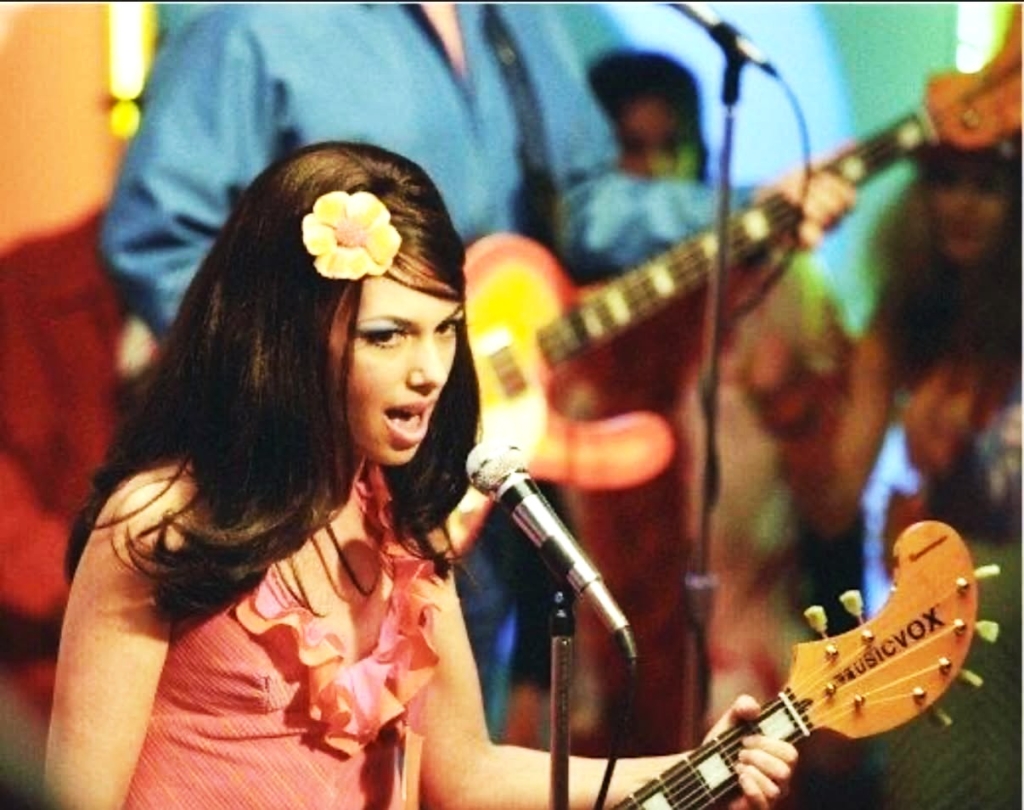
Susanna Hoffs of The Bangles (foreground) and singer-songwriter Matthew Sweet played Musicvox Spacerangers in the 2002 movie, ‘Austin Powers in Goldmember’.
How the instruments wound up in the movie is a somewhat extended tale, but it started with veteran session musician and Cherry Hill native Jim McGorman, whose credits include performing with the Goo-Goo Dolls, the New Radicals and singer-songwriter Michelle Branch. McGorman was familiar with Musicvox and spread the word in music-business circles.
“And then I get a phone call from Matthew Sweet,” explained Eichen, the married father of three grown children. “He called me up and he said, ‘We’re making another [“Powers”] film and we’re gonna have the band in it, but this time I wanna use your instruments.’”
To this day, it is arguably his company’s crowning achievement, one, he suggested, that will help Musicvox be remembered “a hundred years from now.”
Keeping it in the family
In this era of corporate and hedge-funds takeovers, it’s a little surprising that Musicvox, which has always sold its products exclusively on the internet, remains a family-owned business. Not that there haven’t been offers.
Eichen, who closed his oral surgery practice in 2012 when he developed a medical condition that negatively impacted the use of his hands, acknowledged he’d been approached by “two major American” guitar manufacturers as well as by “some very wealthy private individuals in the U.S. and Canada.” But ultimately, with prodding from his children, he passed on the offers.
“The discussions I had with the kids were, ‘What happens if we sell it for that amount? What happens if we sell it for twice that amount? What if we sell it for five times that amount? Then what are we gonna do, start another company? No, we’re not starting another company.’
“In other words, I realized that — it’s a trite thing to say — the value of the company to me and my family was not monetary.”
Three decades later, Eichen still finds the Musicvox story a little tough to comprehend. And what would his reaction have been had, 30 years ago, he’d been told this was how it would unfold?
“I would,” he insisted, “have said, ‘Impossible!’ ” ••
For more, go to musicvox.com.
To watch a documentary about Matt Eichen and Musicvox guitars, go to www.youtube.com/watch?v=CiBl_knbIlA


