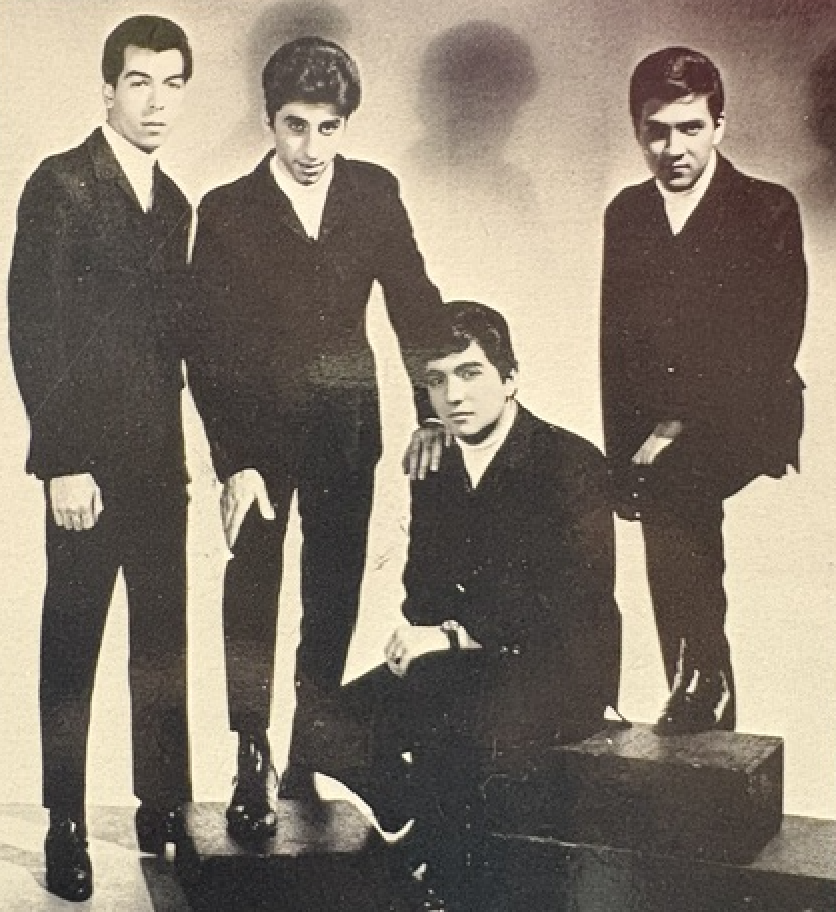
Billy & The Essentials from 1965. Billy Carlucci is the one sitting.
If you’re from the neighborhood and grew up during the late 1950s and early-to-mid 1960s, you surely know who Billy Carlucci is. Carlucci and his group The Essentials scored a number of hits during this period, including “The Dance Is Over,” “Maybe You’ll Be There,” “Over The Weekend” and “Babalu’s Wedding Day.” By his count, the man from Dudley Street in South Philly and 56th & Whitby in Southwest Philly has written over 1,000 songs during the course of his career, which included stints as an independent songwriter and producer for many major record companies – among them Buddah Records, where he produced and sang lead and backing vocals on every track on the 1910 Fruitgum Company’s 1968 album Goody Goody Gumdrops (among the fans of the title song are Howard Stern and Paul McCartney).
These days, the 81-year-old Carlucci performs regularly at Vera Bar and Grill in Cherry Hill, New Jersey. He still possesses his trademark multi-octave vocal range, hitting high notes that could shatter glass. Hearing him sing now, you’d think he was back on the street corner harmonizing, and it was 1959 again.
Billy, take me back to the beginning. How did it all start for you?
What made me want to sing harmony was hearing Danny and the Juniors harmonizing on the corner – they were called the Juvenairs then, they didn’t have a record out yet. Danny Rapp (the late lead singer of Danny & The Juniors) lived right around the corner from me, Dave White (songwriter and member of the group) lived a block away. They used to rehearse on the corner.
Danny had a set of drums in his garage – he was a great drummer, a lot of people didn’t know that – and I could hear him from around the corner (laughs). I said, “Wow, this guy’s a great drummer, these guys sing well … I hope they do good.” Three days later, I turned on ‘American Bandstand’ and they were singing “At the Hop”! I said, “Hey, I know these guys – I want to do that, too!”
You were duly inspired!
I was 13 years old, and I was writing songs and singing Frankie Lymon records. I looked around, and me and my friend Pete Torres put a group together called Little Billy and the Crystals (later changed to Billy and the Essentials). I made them sing the songs that I wrote.
One thing led to another, and I ran into Dave White and his songwriting/production partner John Madara. Madara had this record shop, Gold Records, at 60th & Market; there was a white piano in the back with a rehearsal space. Madara, White and Aram Boornazian, who I also knew, had a production company, MWB Productions. They were producing artists and groups like Maureen Gray and The Sherrys. I told Johnny and Dave, “I have this group, we’re really good.” They said, “We’d love to hear them.” So me and the guys rehearsed “The Dance Is Over,” which was a Shirelles song. We went in the next day, sang the song and they flipped out!
Oh wow! What year was this?
It was 1958; by this time I was 14. A week later, they took us to New York and we recorded at Bell Sound Studios – the biggest studio in New York. They had a 30-piece orchestra. Can you imagine being a young kid and having an experience like that?
You were like this child prodigy – not only did you sing, but you also wrote songs.
My mother put me on the train to New York, and I took a cab to the Brill Building (the mecca for pop music songwriters in the early 1960s). I couldn’t get in to see anybody – they shut the door in my face. So, I was in the hallway leaving, and this fella said, “Hey, can I help you?” I said, “I’m trying to get in to see somebody and play my songs.” He said, “Wait a minute, I’ll get you in.” This guy got me in to see Morris Levy (the owner of Roulette Records), and he bought three of my songs for $100 each.
Do you know who that guy was that got me in the door to see Morris Levy?
Tell me.
Johnny Maestro (lead singer of the Crests and Johnny Maestro & The Brooklyn Bridge).
I don’t believe it!
He really started my career as a songwriter.
Speaking of songwriting, early on you partnered with Leon Huff long before he hooked up with Kenny Gamble. Tell me about that partnership.
We got along great! We laughed all the time. We wrote 10 songs every day. And then Leon said, “I’m going to write at home, get them halfway done, and you do the same thing.” So that’s what we did – he’d write 20 songs, I’d write 20 songs, and we’d finish them at our office in the Shubert Building.
Let’s get back to Billy and the Essentials. Not surprisingly, Jerry “The Geator With The Heater” Blavat was the first to play “The Dance Is Over” in Philadelphia.
Nobody would play “The Dance Is Over.” He played “The Dance Is Over.” He was the first person to play it. I did a lot of record hops with Jerry. He loved “The Dance Is Over,” he loved “Maybe You’ll Be There.” He didn’t like “Over The Weekend.” His favorite song that I recorded was “Remember Me Baby,” written by Barry Mann and Cynthia Weil (the famous Brill Building songwriting team).
Things haven’t been the same since The Geator passed.
That’s right!
One last thing: I was at one of your shows and, after performing “Babalu’s Wedding Day,” you mentioned that you got an email from Lenny Kravitz saying how much he loved Billy and The Essentials’ version of the song.
I couldn’t believe it! I thought that it was strange that he could even find that record. He emailed me and said, “Billy, I’ve been trying to get a hold of you. ‘Babalu’s Wedding Day’ is my favorite record. I just wanted to let you know that.” ••


