BY CHUCK DARROW
To the rest of the world, those four letters in that sequence are meaningless. But here in the Delaware Valley, they represent an important, one-of-a-kind strand in the region’s cultural fabric.
For 58 years, the radio station that occupies the 93.3 frequency on the FM band has been a constant for local rock music fans. From Iron Butterfly and Jimi Hendrix to Billy Joel and Bruce Springsteen to Nirvana and Soundgarden and beyond, the station has been, as one of its classic marketing slogans put it, “the home of rock & roll.”
Considering that, historically speaking and regardless of format, radio stations tend to change programming strategies as well as call letters and occasionally even dial positions every five to 10 years, what ’MMR has accomplished — a single format and the same call letters at the same frequency for almost six decades — is extremely rare in the 125-year history of commercial broadcasting.
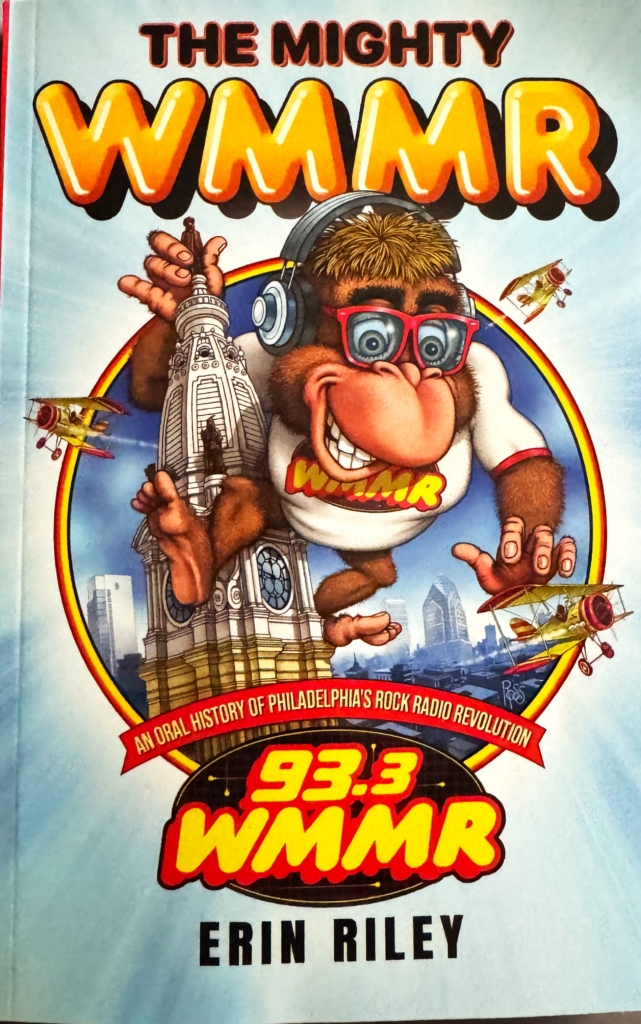
Despite WMMR’s status as a local institution, its history has never been publicly disseminated — until this Friday, that is. That’s when Temple University Press officially releases ”The Mighty WMMR — An Oral History of Philadelphia’s Rock Radio Revolution.”
The breezy, informative book that primarily covers the 1960s, ’70s and ’80s features reminiscences from almost five dozen people including former ’MMR programming execs and on-air personalities, among them “Morning Zoo” keeper John DeBella, the beloved Pierre Robert who last year died suddenly at age 70 and Mark Goodman, who left the outlet in 1981 to become one of the original MTV “VJs.” Also represented are musicians including members of local rock band The Hooters and Bun E. Carlos of Cheap Trick. Other participants include record-industry and concert-promotion figures (full disclosure: I am also quoted).
Within its pages are scores of unabashed anecdotes that offer an intimate look at the station’s history, with a number of them keying on the often-prodigious recreational drug use that fueled the operation during the 1970s and ’80s.
Attention is also paid to the history of radio in general (local broadcasting in particular) and the pivotal role WMMR played in the careers of a number of artists, including Bruce Springsteen and Billy Joel, both of whom have long acknowledged their debts to the station.
“The Mighty WMMR” was reported and written by Erin Riley, who served as the station’s music director from 1983-91. As she explained during a recent chat, the idea for the book originated with its publisher.
“They approached me in February 2024 and said, ‘We’re interested in doing a book about WMMR in its heyday. We really feel like we could bring a book like that to an audience.’
“They were looking for somebody to do that, and I had already written and self-published a memoir called ‘A Dark Force.’ They knew that my book had been well-reviewed and received, and so they figured I could write it.”
Initially, she continued, the plan was for her to write a standard history, with the narrative buttressed by quotes. But former WMMR DJ Anita Gevinson suggested there was a better approach.
“She said, ‘People love oral histories, they’re kind of the hot format. It’s a lot like a written documentary. And if you’re already talking to all these people and recording it, I really think you should look into that,’” recalled Riley. “I thought that was pretty smart.
“And what I did was, I started looking into other oral-history books about music in general … and radio stations. And it seemed as though she was right. And I [decided to] go ahead with this because after speaking with [pioneering late-night disc-spinner] Michael Tearson and John DeBella, I realized I’m funny, but I’m not that funny. It’s like I could tell a story, but if I’m paraphrasing a story of John DeBella’s, it’s never gonna come out as genuinely funny as it would if he were saying it. So that’s how it turned into an oral history.”
For those who weren’t rock-music fans during the period covered in the book, or are too young to have any first-hand knowledge of WMMR in the ’70s and ’80s, it might seem a somewhat frivolous and/or irrelevant subject. But Riley insisted there’s a bigger-picture story worth telling.
She noted that many of the folks she interviewed spoke of “how important terrestrial radio was to people’s lives, especially when they were young. How it helped to connect them to their friends and musical tastes, and also what to do. What concerts are you gonna go see? What records are you saving your money for when they come out? What articles are you reading in [the then-influential music magazine] ‘Cream’ or ‘Rolling Stone?’
“We didn’t have all the distractions that kids have today. There were no video games. There was no Spotify, no on-demand movies. All we had was music, you know, and whatever TV shows were on Friday nights and Saturday mornings. You couldn’t even tape those things; we didn’t even have [home-video technology] back then.
“So, radio was important and because it was so important to so many different people, it also really built a sense of community [among listeners]. And that’s really what the crux of the book is, it’s about community. Because there’s the radio station and the DJs and there are the listeners that are dependent upon the radio station’s programming.
“You could be driving down the Schuylkill Expressway and you’re jamming to some great song on the radio, and you look over at the car next to you and somebody’s doing the same thing. They’re bopping their head and they’re listening to the same music. And you’re like, ‘Yeah!’ And it made you feel connected to other people. And I think that’s something missing in today’s society. So yes, it was important to capture the sense of community that radio brought, especially WMMR.”
Given that change is the one constant not just in the world of radio, but in the world as a whole, Riley understands that, despite it being the market’s top-rated music outlet according to the Nielsen organization, WMMR’s continued existence, while likely, is not guaranteed. However, she is optimistic.
“It’s always a possibility” its current owners, Beasley Media Group, could pull the plug, she conceded, “but I think WMMR has a lot of strong ground to stand on. And there are people that still just love it and live by it.” ••


