BY JOE FELICE
The recent nationwide celebrations of America’s 250th anniversary allowed me the chance to reflect upon the extraordinary legacy of my great-grandfather John Faulkner who worked as a carpenter at the Philadelphia Navy Yard following the Great War. What interests me the most about his Navy Yard service is the large veil of mystery that still surrounds the details of his assigned duties. Although the past few years have revealed documentation confirming Faulkner’s service, a great deal remains unknown about the specifics of his work at the Navy Yard.
In 2019, I found a picture of my great-grandfather donning a WW I-era U.S. Navy uniform. At the time, my Mom and I were paging through an old family album and we were both clueless as to the sailor’s identity. Both of us were eventually able to identify the sailor as being her grandfather when we found John and Amelia Faulkner’s wedding picture taken in 1913. Surprisingly, confirming the identity of the sailor as being her grandfather only caused more confusion since my mom never knew about his naval service. Hence, I decided to retrieve whatever information may still exist that could fill in the gaps of his long-lost legacy.
In May 2022, the first clue finally surfaced when the author of the book The Philadelphia Navy Yard: A History from the Birth of the U.S. Navy to the Nuclear Age shared with me that sources he cited in his book confirmed Faulkner’s service. The author detailed how these sources made references to my great-grandfather’s service aboard the Samoset tugboat at the Philadelphia Navy Yard in 1920. Also, they noted that he was assigned to the detail that dismantled captured German warships for scrap metal. I was relieved when I discovered that the 1920 census record confirmed that Faulkner was a carpenter at the Navy Yard.
The following month, in June 2022, Corey Stewart, an archivist at the National Archives in St. Louis, Missouri, searched through their collection of Coast Guard, Navy military files, Navy Civilian Personnel Folders, Navy Civilian Service Record Cards, Civil Service Cards, Civilian War Department Folders, Merchant Marine Licensing Files and Merchant Marine Enrollee files. Unfortunately, she was unable to find any records confirming Faulkner’s service.
Finally, in August 2022, a major breakthrough occurred. Nathan Jordan, an archivist at the National Archives in Atlanta, Georgia, discovered a WW I Classification List stating Faulkner’s registration with the Emergency Fleet in December 1917/January 1918. Unfortunately, along with this breakthrough another layer was added to the mystery of his service. Emergency Fleet uniforms had two white stripes around the collar. Faulkner’s uniform is an official U.S. Navy issue with three stripes around the collar and a white braid wrapped around his right arm indicating he was between the ranks of Apprentice Seaman and Seaman First Class. Therefore, at one point according to the classification list he registered with the Emergency Fleet and at another date per the photo served in the Navy.
In March 2023, I contacted Winslow Marine in Falmouth, Maine. At one point in the late 1960s, the company owned the Samoset tugboat. Then, in the late 1980s, sold the tug. Although they had no records about Faulkner’s service, they kept the tugboat’s steering wheel, propellor and copper air scoops. I was able to see pictures of these parts and see some of what my great-grandfather had seen with his own eyes.
In April 2023, the staff at Independence Seaport Museum in Philadelphia notified me that their holdings did not shed any light on Faulkner’s service aboard the Samoset. A month later, Stephen Charla, an archivist at the National Archives in Philadelphia, conducted an extensive search of its records. Unfortunately, his search was also fruitless.
In October 2024, a very kind person who wishes to remain anonymous reviewed some of the Samoset muster rolls dated 1920, which are kept at the National Archives in Washington, D.C. The muster rolls that were reviewed were dated September and December 1920. Much to everyone’s frustration Faulkner’s name did not appear in these records. Perhaps Faulkner’s name is mentioned in other records from that year that were not reviewed.
Since so much mystery still surrounds the specifics of John Faulkner’s Navy Yard service, I decided to learn more about the working conditions he encountered. Several issues of the Hog Island News, a paper that was issued to yard workers during the Great War, often describe the hazardous conditions faced by Navy Yard employees. Every conceivable obstacle from hot weather environments to dangerous heavy equipment were frequently detailed and helped to add depth to Faulkner’s legacy of service to his country. A legacy that I was honored to learn about and continue to recognize as our nation celebrates our 250th anniversary. ••
Anyone with historical information, photographs or documents related to the Samoset tugboat following World War I or the work of the Emergency Fleet at the Philadelphia Navy Yard during that period is encouraged to contact editor Michelle Donnelly at michelle@donnelly.media. The information will be shared with Faulkner’s great-grandson, who is continuing to piece together his great-grandfather’s naval service and hopes to uncover more about this little-known chapter of his family’s history.
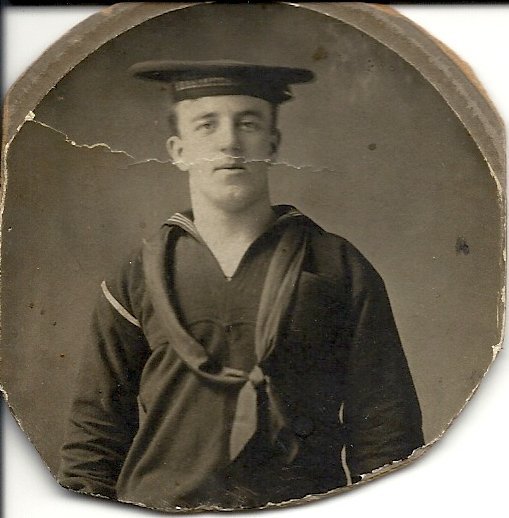
John Faulkner, circa 1920.


